

You can use PepDose’s Body Mass Index calculator (BMI) to calculate your BMI value, while taking into consideration your sex, weight, and age. Also, since we have many international visitors, we’ve added the option to either use the “Metrics Units”, where you can use measurements such as centimeters and kilograms; in addition to the US Units - inches and pounds.
BMI = 22.5 kg/m²
(Normal)
Underweight
< 18.5
Healthy weight
18.5 - 24.9
Overweight
25 - 29.9
Obesity
> 30
Human bodies are oddly shaped and it’s not easy applying any generic mathematical formula to it. But for the sake of simplicity, a Belgian mathematician and statistician Adolphe Quetelet came up with this calculation, because we needed a way to study the population as a whole, rather than any single individual. His calculation proved to be so successful, it stuck all the way to modern days.
So what is this formula? - It goes like this BMI = kg/m2; in other words, you divide your weight by the square of your height. One important caveat about BMI is that it’s not an end all be all indicator of one’s “body fatness” or their weight. It’s a number that quantifies the tissue mass and puts you into a certain category, based on the number of the entire population. You can be:
depending on the BMI range your results fall under. These categories are based on the general population and each one is associated with its own level of health risks (or the probability of developing them).
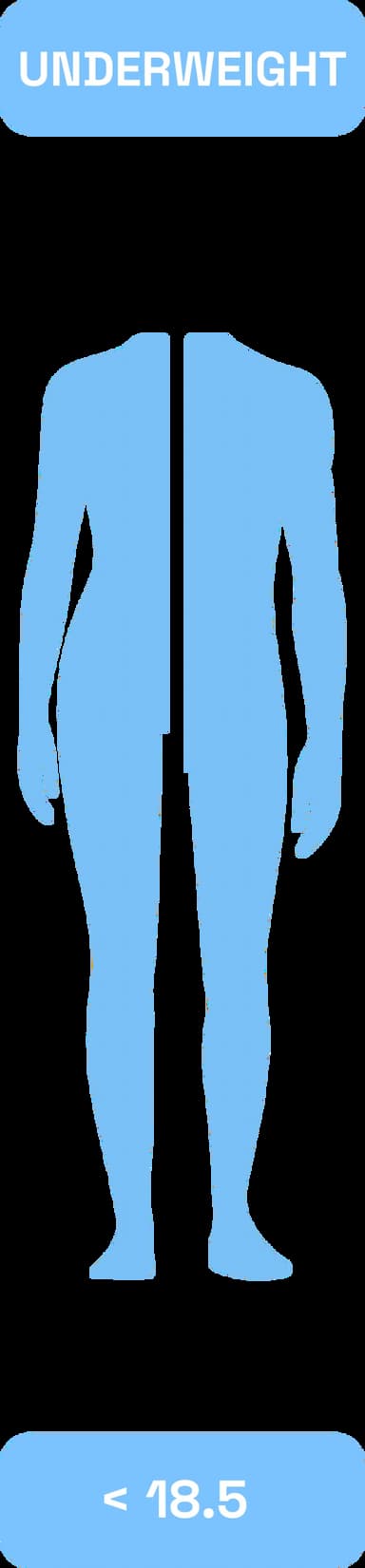
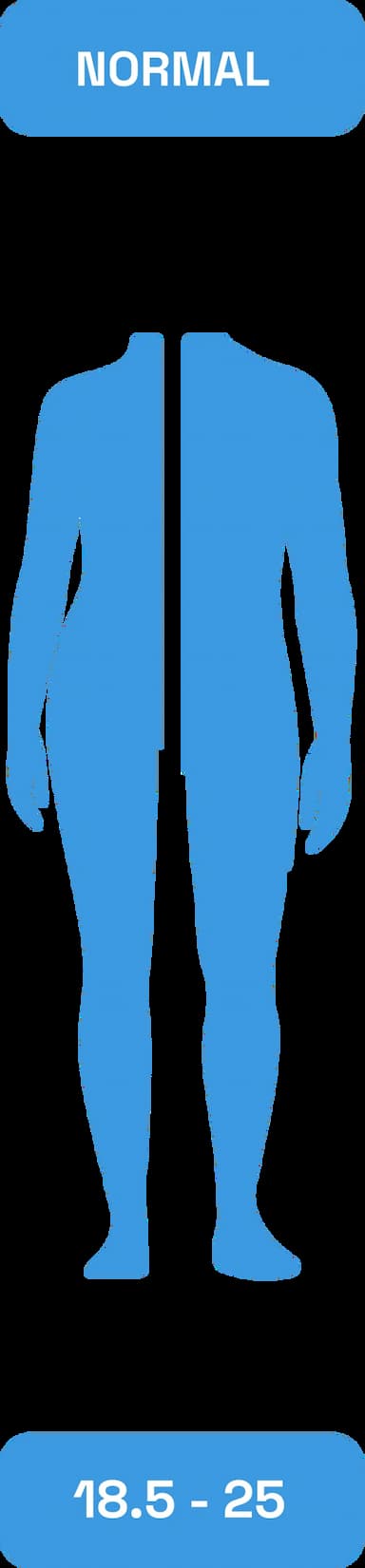
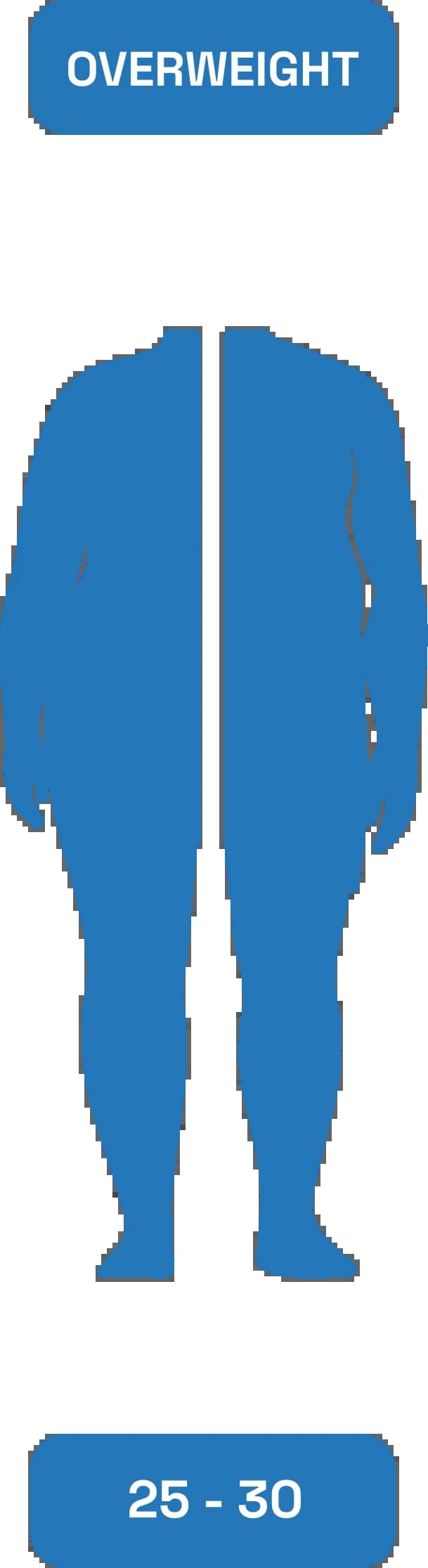
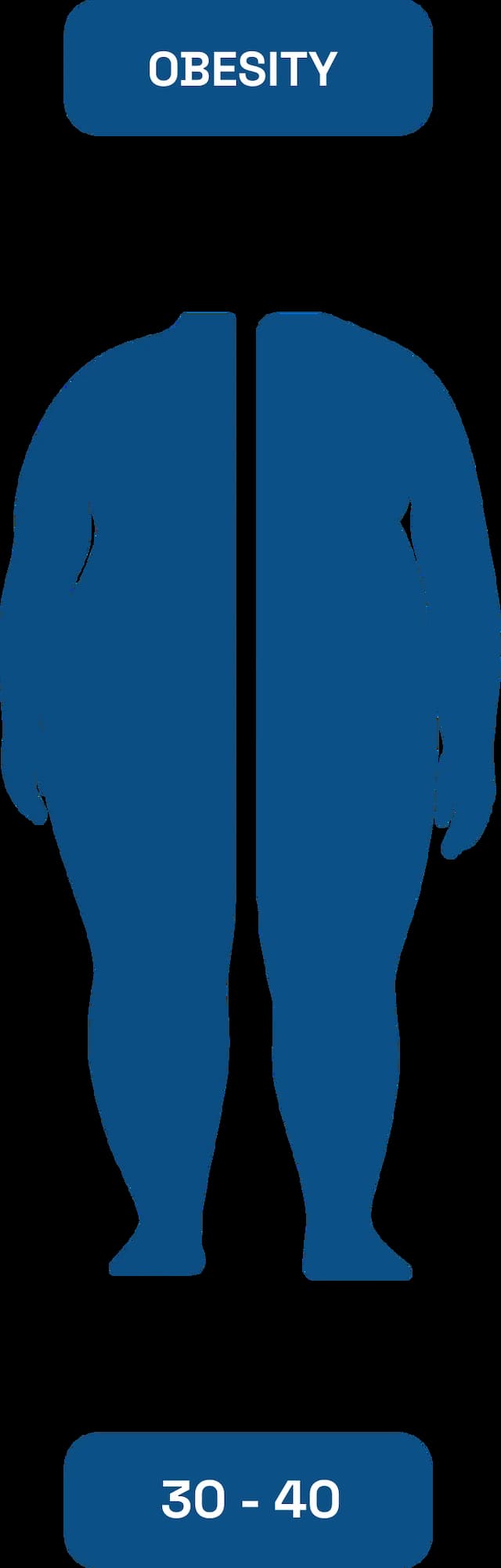
But, as we already said, this number is just an indication researchers/doctors use to point them into a certain direction - whether further tests are needed. Though BMI proved relatively accurate and reliable when used for general population, it becomes less accurate when used in extreme cases such as:
Why? Because BMI calculation “doesn’t” know if the number is high because of excessive fat or muscle. In other words, if you are a big buff dude, your BMI might still put you in the “overweight” category, simply because your number is just too high.
Based on your BMI, your result will put you into one of the following groups:
| Classification | BMI (range) | Health Risk |
|---|---|---|
| Severe underweight | < 16 | Increased |
| Moderate underweight | 16 - 17 | Increased |
| Mild underweight | 17 - 18.5 | Moderate |
| Normal | 18.5 - 25 | Least |
| Overweight | 25 - 30 | Increased |
| Obese class I | 30 - 35 | Increased |
| Obese class II | 35 - 40 | Very high |
| Obese class III | > 40 | Extremely high |
When talking about BMI calculations, we saw that this is not, by any means, an exact science. Similar can be said for the BMI ranges and percentages. For simplicity’s sake, we just talk about and use one scale, but there are many different ones. The most commonly used are:
| Category | BMI Range (kg/m²) | Men (%) | Women (%) |
|---|---|---|---|
| Underweight | < 18.5 | < 8 | < 21 |
| Normal weight | 18.5 - 24.9 | 8 - 19 | 21 - 33 |
| Overweight | 25 - 29.9 | 19 - 25 | 33 - 39 |
| Obese class I | 30 - 34.9 | 25 - 30 | 39 - 44 |
| Obese class II | 35 - 39.9 | 30 - 35 | 44 - 49 |
| Obese class III | ≥ 40 | > 35 | > 49 |
| BMI | Men - ages 29-39 (%) | Women - ages 29-39 (%) |
|---|---|---|
| 18.5 | ~8 | ~21 |
| 22 | ~13 | ~26 |
| 25 | ~17 | ~30 |
| 27 | ~20 | ~33 |
| 30 | ~25 | ~38 |
| 35 | ~30 | ~43 |
This table is mostly used in sports and general fitness:
| Category | Women (%) | Men (%) |
|---|---|---|
| Essential fat | 10 - 13 | 2 - 5 |
| Athletes | 14 - 20 | 6 - 13 |
| Fitness | 21 - 24 | 14 - 17 |
| Average | 25 - 31 | 18 - 24 |
| Obese | > 32 | > 25 |
Above-listed charts mostly apply on adults, but if we’re talking about children (starting at the age of 2) and teens, the numbers are slightly modified:
| Category | Percentile |
|---|---|
| Underweight | < 5% |
| Healthy weight | 5 - 85% |
| Overweight risk | 85 - 95% |
| Overweight | > 95% |
We all know about the risks associated with excess weight and obesity, but not many people talk about the dangers of being underweight and malnourished. To help you fully comprehend the issue, we’re going to be talking about the issues from both ends of the spectrum.
Though not as severe as being obese, being underweight comes with its own set of issues. Some of the most common are:
Though being underweight is not a disease in itself, it might be an indication of an underlying cause (illness) and it almost always requires further investigation - both physical and psychological, as a person might also be suffering from some form of anxiety.
Being overweight (obese) increases the risk of a number of serious health problems and diseases, some of which are:
As you can see, the list is quite a serious one with a number of severe health problems, some of which might be directly linked to a fatal outcome. This is why being overweight is by no means a joke, but something to be taken quite seriously and dealt with utmost care. As a general rule of thumb, you should keep your BMI levels below 25 kg/m2, to stay on the safe side. Should you cross it, consider drastic changes in your lifestyle before it becomes too late.
The BMI calculator you see at the beginning of the page uses the “simplest” way of assessing your BMI based only on a few measurements (mainly height, weight, and gender), but if you want a calculation that’s a bit more accurate, but requires some work on your part, you can employ US Navy’s Body Fat Circumference method. What you’ll need to do is measure your:
Body Fat Percentage = 86.01 x log10(waist - neck) - 70.041 x log10(height) + 36.76
Example calculation for a male who is 70in (178cm tall), whose neck is 16in in circumference, and waist is 34in.
This is what the calculation would look like:
BFP = 86.01 x log10(34-16) - 70.041 x log10(70) + 36.76
= 86.01 x 1.255 - 70.041 x 1.845 + 36.76
= 107 - 129.2 + 36.8 = 14.6%
So, the estimated body fat percentage for this person would be 14.6%.
Body Fat Percentage = 163.205 x log10(waist + hip - neck) - 97.684 x log10(height) - 78.387
Example calculation for a woman who is 65in (165) tall, whose neck is 13in in circumference, waist is 30in, and hips are 38 inches.